
What is a Vane Pump? Working Principle, Types & Applications [2026 Guide]
A vane pump is a high-efficiency positive displacement pump designed to deliver a constant flow rate regardless of varying pressure conditions. Known for its self-priming capabilities and robust performance, this pump utilizes a series of vanes mounted on a rotor to pressurize and move fluid through a system.
The history of the vane pump dates back to June 16, 1874, when Charles C. Barnes from New Brunswick patented the very first design. Today, modern vane pumps have evolved significantly, featuring surface contact between the stator and rotor to enhance efficiency and durability in diverse industrial environments.
How Does a Vane Pump Work? (Step-by-Step Working Principle)
Understanding the vane pump working principle is essential for optimizing hydraulic systems. The process follows a precise mechanical sequence:
Power Delivery: Power is supplied via an electric motor or engine to the pump shaft.
Rotor Rotation: The shaft drives the rotor, causing the mounted vanes to rotate within the pump cavity.
Vacuum Generation: As the rotor spins, a vacuum is created inside the pump, drawing fluid into the inlet port.
Centrifugal Force: Centrifugal force pushes the sliding vanes outward, maintaining contact with the pump wall.
Pressurization: The vanes capture the fluid, converting kinetic energy into speed as it moves toward the volute casing or diffuser area.
Discharge: The volute casing's reducing area converts fluid speed into pressure, discharging the pressurized liquid to the desired application.
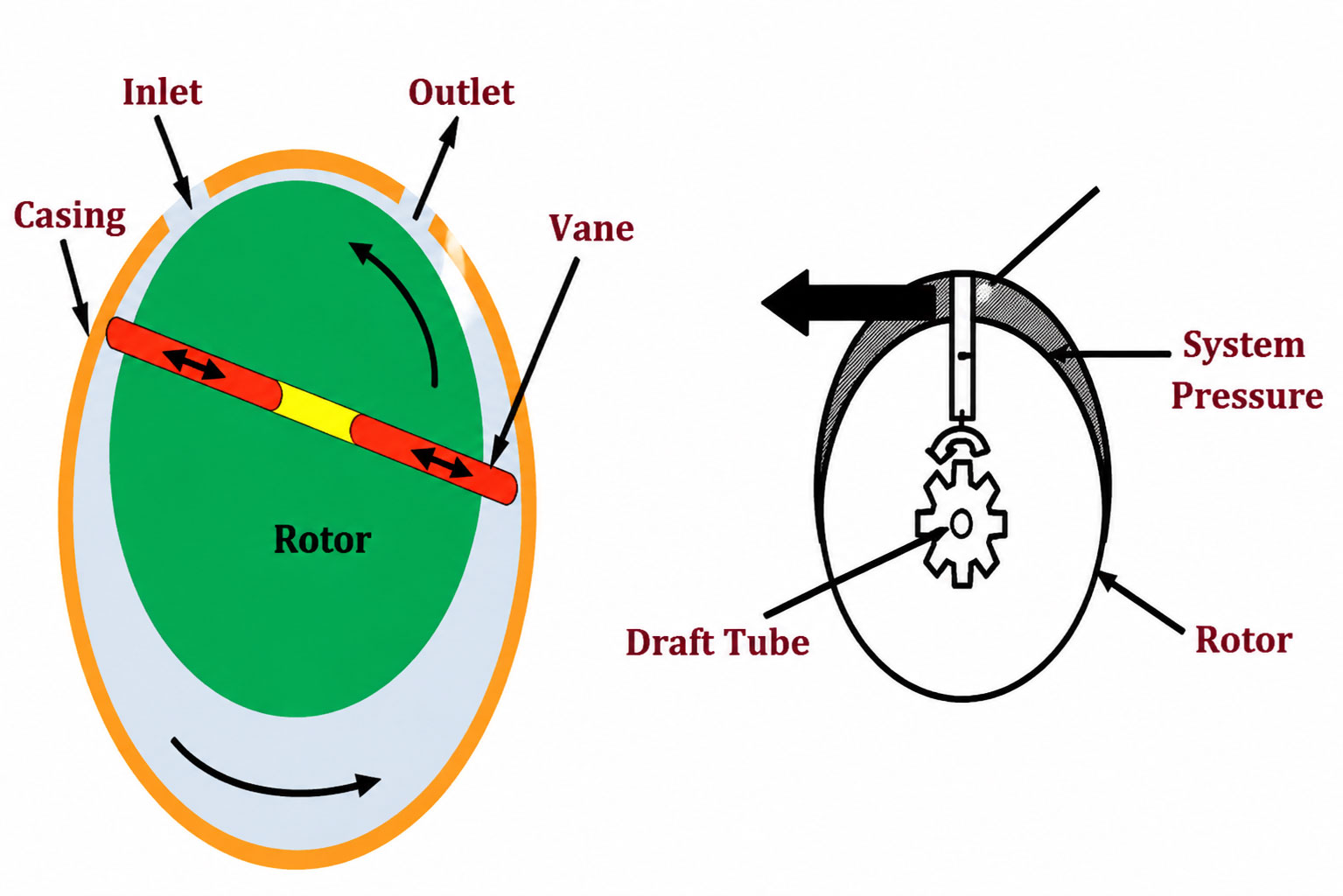
Key Components of a Hydraulic Vane Pump
A professional-grade hydraulic vane pump consists of several critical components that ensure high volumetric efficiency:
Casing: The outer protective shell that secures internal components like the rotor and shaft from external damage.
Inlet & Outlet Ports: These act as one-way valves for sucking in and discharging pressurized fluid.
Shaft: Connected to the motor, it transfers rotational energy to the rotor.
Rotor: The heart of the pump, featuring radial grooves to house the vanes.
Vanes (Sliding Vanes): Rectangular blades that move freely in the rotor slots to capture and pressurize fluid.
Cam Ring: A ring installed on the inner housing wall that guides the vane tips.

3 Main Types of Vane Pumps
Depending on the application, vane pumps are categorized into three primary designs:
1. Unbalanced Vane Pump
The unbalanced vane pump is characterized by a cylindrical rotor installed on an offset within a circular housing. This design creates a pressure difference between the suction and discharge valves, resulting in a lateral thrust on the shaft, which can impact bearing life.
2. Balanced Vane Pump
The balanced vane pump features an elliptical casing where the rotor and casing share the same center. By utilizing two inlet and two outlet ports positioned opposite each other, it balances thrust forces, eliminating lateral thrust on the rotor shaft. This design offers a superior service life—often exceeding 24,000 hours in industrial applications.

3. Variable Displacement Vane Pump
The variable displacement vane pump allows for adjustable flow rates by changing the size of the pump pocket. This is achieved using a reaction ring and adjusting screws that shift the offset between the rotor and the ring center, making it highly versatile for fluctuating demand.

Brand Cross-Reference
| Vane Pump Type | Market Standard / Brand | YHDE Solution (100% Compatible) |
| High-Pressure Pin-Type | Denison T6 / T7 Series | YHDE T6/T7 Series |
| Intra-Vane Industrial | Vickers V / VQ Series | YHDE V/VQ Series |
| Super Quiet Series | Tokimec SQP Series | YHDE SQP Series |
Technical Specifications: Fluid Suitability
Vane pumps excel at handling specific types of liquids:
Best Suited For: Low-viscosity liquids such as alcohols, solvents, ammonia, and LPG.
Medium Viscosity: Can handle medium-viscosity fluids effectively.
Limitations: Generally not suitable for highly viscous fluids or abrasive liquids.
Advantages and Disadvantages of Vane PumpsPros (Advantages)
Constant Flow: Delivers a steady supply with negligible pulsation.
Self-Priming: Capable of drawing fluid without external priming.
Efficiency: High volumetric and overall efficiency.
Compact Design: Lightweight and robust construction.
Low Noise: Operates with minimal vibration and noise levels.
Cons (Disadvantages)
Pressure Relief: Requires a relief valve to prevent damage from sudden stoppages.
Fluid Sensitivity: Not suitable for abrasive or extremely high-viscosity fluids.
Filtration Needs: Requires high-quality filtration to prevent failure from foreign particles.
Industrial Applications
Vane pump applications span across multiple critical sectors:
Automotive: Power steering systems and air conditioning.
Energy & Aviation: Fuel transfer, LPG cylinder filling, and deicing services.
Food & Beverage: Processing machines and beverage dispensers (coffee/espresso).
Oil & Gas: Bulk transfer of NH3 and LPG.
Vane Pump vs. Centrifugal Pump: Comparison Table
| Feature | Vane Pump (Positive Displacement) | Centrifugal Pump (Dynamic) |
| Principle | Positive Displacement | Centrifugal Force |
| Priming | No priming issues (Self-priming) | Facing priming issues |
| Flow Control | Excellent capability to control flow | Poor capability to control flow |
| Efficiency | High Volumetric Efficiency | Generally High Overall Efficiency |
| Common Use | Specialized Industrial Applications | Most commonly used pump type |
"Need a quote for a Vickers or Denison replacement? Get a factory-direct price in 2 hours."
Frequently Asked Questions: Vane Pump Principles & Applications
A rotary vane pump operates on the principle of increasing and decreasing cavity volumes. Inside the pump, a slotted rotor is eccentrically mounted within a cam ring. As the rotor spins, centrifugal force (along with internal hydraulic pressure) pushes the vanes outward, forcing them to ride continuously along the inner surface of the ring. This creates sealed chambers of varying sizes between the vanes. Near the suction port, the chamber volume increases, creating a vacuum that draws fluid into the pump. As the vanes rotate toward the discharge port, the volume decreases, forcing the highly pressurized hydraulic fluid out into the system.
The distinction lies in their internal geometry and fluid paths. In an unbalanced vane pump, the rotor is eccentric to a perfectly circular cam ring, featuring only one suction port and one discharge port. This generates a heavy, one-sided hydraulic load on the rotor shaft, limiting maximum working pressure. Conversely, a balanced vane pump (such as the Vickers V/VQ or Tokimec SQP series) utilizes an elliptical cam ring with two separate suction and two discharge ports positioned directly opposite each other. The resulting forces cancel each other out, achieving zero net radial force on the bearings. This allows balanced pumps to reliably handle high-pressure workloads up to 210–320 bar with a significantly longer service life.
Because vane pumps deliver high volumetric efficiency (90% to 95%), consistent flow, and exceptionally low operating noise (well under 70 dB), they are the preferred "heart" for precision industrial machinery. Their primary applications include plastic injection molding machines, die-casting equipment, large hydraulic presses, and automated industrial power units. Furthermore, due to their strict adherence to universal standards (such as SAE 2-bolt/4-bolt mounting flanges), premium replacement vane pumps are widely sourced by MRO service providers as exact "drop-in" alternatives to minimize system downtime across factories globally.
💡 Maintenance Tip: To shield the precision CNC-machined components of your vane pump from abrasive wear, always perform a complete fluid flush and replace your return line filter with a fresh 10-micron absolute filter during installation.