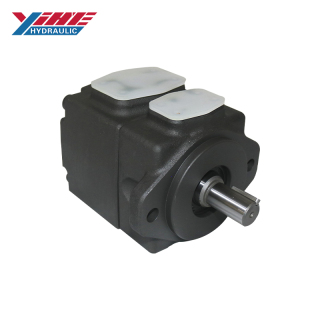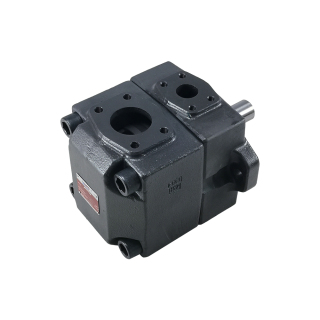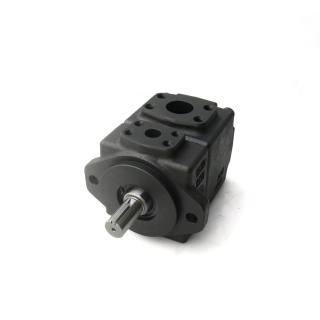
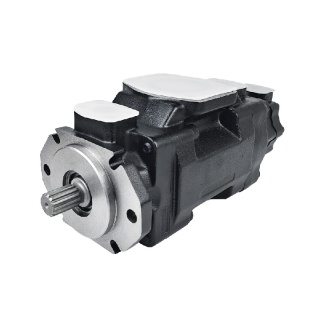
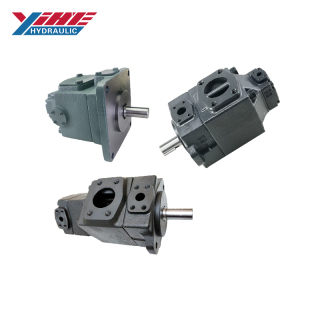
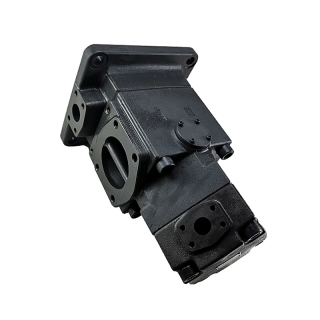
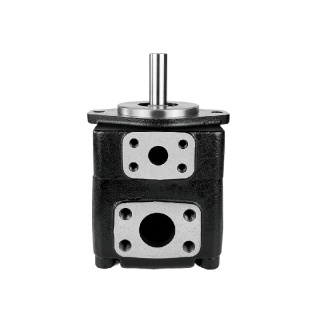
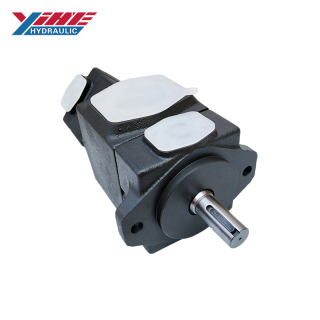
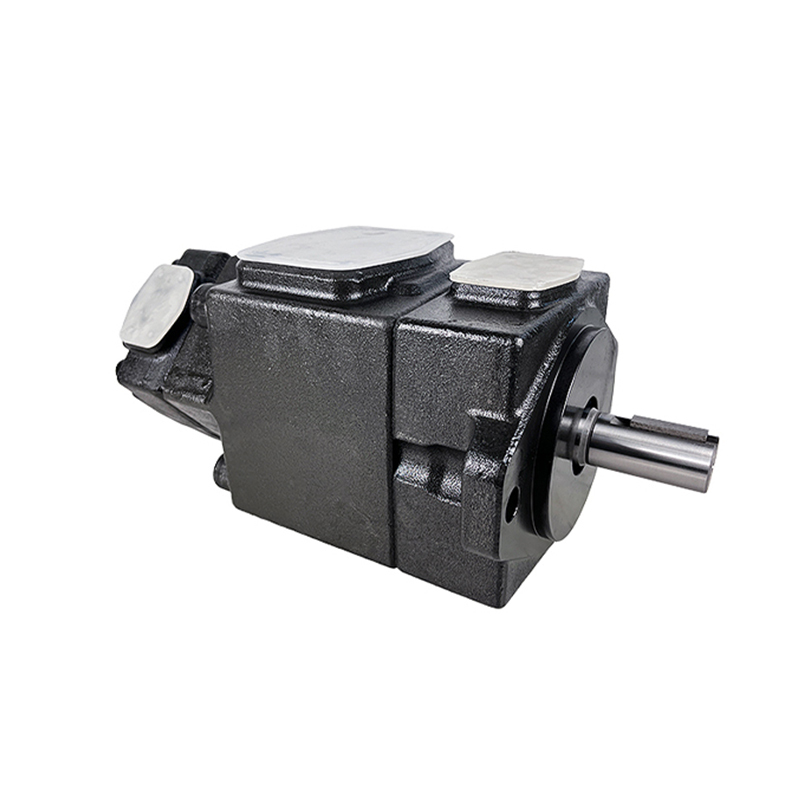
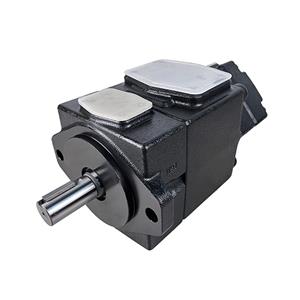
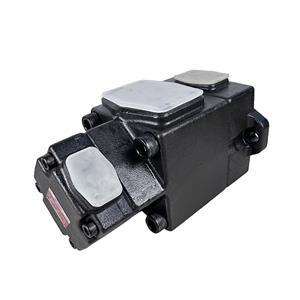
PV2R23 Double Vane Pump: 26/94 Replacement Configuration
Request a YHDE Yuken-type replacement for a PV2R23-26-94-F-REAA-41 application. Identify the small-volume and large-volume sections, complete model, port arrangement and operating duty before ordering a complete pump or repair parts.
Confirm the 26/94 assembly against the offered specification. Regional Yuken single-pump data include code 26, but the standard PV2R23 combination table examined starts its small section at 41. A component code alone does not approve the complete combination. Keep the actual marking and request the matching assembly drawing and ratings.
Keep the Two Sections and Their Codes Distinct
| Item | Reference and selection requirement |
|---|---|
| PV2R23 | Combines PV2R2 small-volume and PV2R3 large-volume sections on one shaft, with a common suction and separate discharges. |
| 26: small-volume section | Yuken India single-pump reference lists PV2R2-26 at 26.6 cm³/rev. Confirm the actual offered assembly and cartridge. |
| 94: large-volume section | Original PV2R3-94 reference lists 93.6 cm³/rev. Confirm the supplied value rather than rounding code 94 into an exact volume. |
| Physical section position | The original PV2R23 drawing places the large section near the drive end and the small section toward the cover. Model-code order is small then large; it is not front-then-rear order. |
| Code 26 scope | The regional single-pump table includes 26, while the examined standard double-pump combination table lists 41–65 for the small PV2R23 section. Obtain variant-specific confirmation for 26/94. |
The family supports separate circuit flows; it does not multiply one section pressure through the other. A high/low circuit also requires suitable external control and unloading arrangements.
Decode PV2R23–26–94–F–R–E–A–A–41
| Item | Reference and selection requirement |
|---|---|
| F after 94 | Flange mounting. A leading F- before the family is a separate fluid/seal designation in original Yuken coding. |
| R | Clockwise viewed from the shaft end. Confirm the actual drive and supplied model. |
| E | Small-volume discharge at left 45° upward, viewed from the shaft end in the reference code. |
| First A after E | Large-volume discharge upward. |
| Second A after E | Suction upward. |
| 41 | Design number. Keep 80/90 standard suffixes, extra letters and modifications exactly as marked. |
EAA describes port positions, not a universal port-thread code. REAR and REAA differ in suction orientation; a near-match search result is not the same configuration.
Verify Fluid, Pressure, Speed and Inlet Conditions
Use a confirmed duty sheet for the actual 26/94 assembly. The India single-pump reference lists both PV2R2-26 and PV2R3-94 up to 210 kgf/cm² with specially specified petroleum oil; its ordinary antiwear-oil column is 175 kgf/cm². These correspond to approximately 20.59 and 17.16 MPa, respectively. Do not relabel 210 kgf/cm² as exactly 21 MPa or apply it to every fluid.
Other regional catalogues may use MPa and different approved oil specifications. State the catalogue edition, oil grade and supplied rating in the quotation. Component pressure figures do not by themselves establish the full assembly approval.
The cited PV2R23 double-pump speed reference is 600–1800 rpm with petroleum oil and up to 1200 rpm with water-containing fluids or phosphate esters. Low-speed starting depends on viscosity. For the large-section code 94, the India reference tightens minimum suction pressure from -0.2 kgf/cm² below 1700 rpm to -0.07 kgf/cm² at 1700–1800 rpm. Confirm the applicable inlet measurement reference and supplied assembly limits.
Specify working pressure, peaks and duration for each outlet, oil viscosity/temperature and timing of simultaneous loading or unloading. Ask for loaded-flow, input and test conditions for the offered unit.
Calculate Each Flow and the Common Drive Requirement
Ideal flow is Q = Vg × n / 1000 using L/min, cm³/rev and rpm. Using the component references 26.6 / 93.6, ideal flows at 1500 rpm are 39.9 / 140.4 L/min; at 1800 rpm they are 47.88 / 168.48 L/min. Actual loaded delivery is lower and must be checked at pressure, viscosity and temperature.
Ideal hydraulic input is P = (Δpsmall × Qsmall + Δplarge × Qlarge) / 600 in kW using bar and L/min. At 1500 rpm and example pressure rises of 150 / 100 bar, the ideal total is 33.375 kW. Actual input includes losses; confirm motor, coupling, common shaft and transmitted torque limits. This illustration does not approve a supplied combination or motor size.
Match Both Discharges, Suction, Mounting and Shaft
Compare complete model and offered assembly drawing, including special prefixes, design standard and extra suffixes.
Check mounting pilot, bolt pattern, shaft diameter/extension/key, coupling and installation envelope.
Identify small and large discharge positions and the common suction. Verify all flange openings, bolt threads and clearances separately.
Keep JIS 41 and North American 4190 drawing references distinct; connection threads can differ.
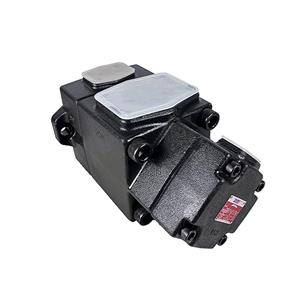
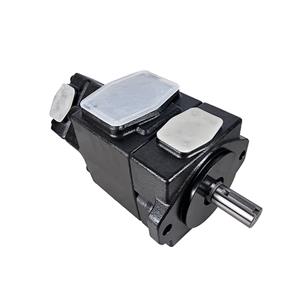
Confirm actual fluid/seal version and any changed porting. A family or photograph match does not certify interchangeability.
Identify the Affected Section and Repair Scope
| Item | Reference and selection requirement |
|---|---|
| One outlet loses flow | Identify small or large section, record loaded flow/pressure/speed/oil temperature, and check controls or relief leakage. |
| Noise / overheating | Inspect inlet restriction, aeration, oil viscosity, alignment and cycle losses before attributing symptoms to a cartridge. |
| Cartridge request | Send full assembly and core markings, actual rotation/design, fluid version, affected section and inspection photos. |
| Retained parts | Inspect housing, shaft, bearings, mating plates and seals. Confirm included parts and any additional work. |
Small-section cartridge orientation and model can differ from a standalone single pump. The original double-pump parts reference uses dedicated small-section identifiers. Confirm the exact kit rather than ordering only by PV2R2 and 26. Availability and repair time depend on identification and inspection.
After an internal failure, identify contamination sources and assess affected tank, lines, filters and controls. Select filtration by required cleanliness, flow and pressure drop. Follow the supplied pump and machine instructions for priming, bleeding, unloaded startup and progressive loading; confirm stable operation before full duty.
Prepare a Model-Specific PV2R23 Inquiry
Enter known details and keep unknowns explicit. Choose a request to prepare the existing site inquiry message; then review it, add your contact email and submit manually.
Select a request to prepare your message. Message preparation is not submission.
The current form has no file attachment field. Describe available nameplate, shaft and port photographs or drawings and ask how to send them. Request an offered full model, drawing match, both section limits, shared drive approval, included parts, price and dispatch estimate. Use the contact page if the form is unavailable.
PV2R23 Selection Questions
Does code order mean front section then rear section?
No. Original double-pump coding lists small-volume displacement first and large-volume displacement second. Confirm physical positions on the assembly drawing.
Is code 26 automatically invalid for all PV2R pumps?
No. Yuken India lists PV2R2-26 at 26.6 cm³/rev. However, the examined standard PV2R23 combination table starts at small code 41, so the exact 26/94 assembly needs variant-specific confirmation.
What does REAA identify?
R is clockwise from the shaft end; E is the small discharge left 45° upward; the first A is the large discharge upward and the second A is suction upward in the reference code.
Are 26 and 94 exact geometric displacements?
They are nominal codes. The component references used here are 26.6 and 93.6 cm³/rev. Confirm actual supplied displacement and loaded performance.
Can both sections always run at 21 MPa?
Do not assume this. Pressure depends on the approved oil, catalogue version and supplied assembly. The cited India table uses kgf/cm² with separate specially specified and ordinary antiwear-oil columns.
Can a standalone PV2R2 cartridge be installed in the small section?
Confirm the actual double-pump core identifier, rotation, design and mating parts. Small-section cartridge arrangements can differ from standalone single pumps.
What should I send for an engineering quotation?
Send full actual model and maker, small/large section codes, working/peak pressures and timing, loaded flow/speed, fluid/inlet conditions, drive, drawings, quantity, destination and date. Add affected-section measurements for repair.
Original Documents and Version Scope
Yuken India PV2R technical reference — p.1 component data, pp.16–19 double-pump selection/limits, p.22 PV2R23 drawing.
Yuken original double-pump catalogue — model code, design-standard drawings and section parts.
Existing site PV2R23 PDF — confirm its edition and supplied-model applicability.
References identify original configurations. Confirm the actual YHDE replacement manufacturer, variant, drawing, limits and supplied parts in the quotation.